
Powered By


 Continue with Facebook
Continue with Email
Continue with Facebook
Continue with Email
Two people can walk into a neurologist’s office with a trembling hand and unsteady steps — and leave with two completely different diagnoses.
Multiple sclerosis (MS) and Parkinson’s disease are both conditions that affect the central nervous system (brain and spinal cord). Both can make it harder to move, think, and feel well. But they’re caused by different problems in the body, they tend to strike at different life stages, and they need different treatments.
If you or someone you love is living with one of these conditions — or trying to understand a new diagnosis — here’s what sets them apart.
Age of onset is an important clue a doctor can consider when determining a diagnosis. MS most often shows up in young adults. The average age of diagnosis is between 20 and 40. MS is also more common in women than in men, according to research published in the journal Cureus.
 Parkinson’s disease tends to occur later in life. It affects about 1 percent of people over age 60. According to research in the New England Journal of Medicine, Parkinson’s is more common in men.
Both conditions can happen outside these ranges. Early-onset Parkinson’s exists, and MS can be diagnosed in older adults, too.
The two diseases damage the nervous system in very different ways.
MS is an autoimmune disease. That means the immune system — which normally fights off germs — mistakenly attacks the body’s own tissues.
In MS, the immune system attacks myelin, the protective coating around the nerve fibers in the brain and spinal cord. When myelin is damaged, this disrupts the nerve signals causing them to slow down or stop.

Parkinson’s disease works differently. In Parkinson’s, neurons (brain cells) slowly die. These cells are located in the area of the brain called the substantia nigra. Neurons make dopamine, a chemical the brain uses to control smooth, purposeful movement.
By the time Parkinson’s disease is diagnosed, more than half of those dopamine-making cells may already be gone.
In summary, MS is driven by the immune system attacking the myelin. Parkinson’s is driven by the loss of brain cells that make dopamine.
MS often follows a relapsing-remitting pattern — meaning symptoms flare up, then improve. In relapsing-remitting MS, the most common form, people have distinct attacks (called relapses) followed by periods of partial or full recovery.
MS progresses over time. Many people transition to a more steady progressive course, called secondary progressive MS.
Parkinson’s disease doesn’t have relapses or recovery periods. It worsens slowly and steadily over time, although the pace is different for everyone. For some people, the disease progresses for 20 years or more.
Both MS and Parkinson’s disease can cause:
But these symptoms often feel different depending on the condition.
Fatigue in MS can hit suddenly and feel extreme — far worse than the amount of activity would explain. It’s often worsened by heat. Fatigue in Parkinson’s is more often tied to the physical effort of fighting muscle stiffness all day.
Constipation is common in Parkinson’s disease and can actually appear years before movement problems begin. Researchers now believe some nonmovement symptoms of Parkinson’s disease, like constipation, may start long before a diagnosis is made.
Bladder problems in MS are more often about urgency or difficulty emptying the bladder — driven by nerve damage.
Depression and anxiety are common in both conditions, but for different reasons. In MS, mood changes can occur when lesions (areas of damage) develop in the brain. In Parkinson’s disease, they’re closely tied to falling dopamine levels and changes in serotonin and norepinephrine (other chemical messengers in the brain).
Tremor — uncontrolled shaking — is closely associated with Parkinson’s, but it can also happen in MS. The key difference is when the shaking occurs.
In Parkinson’s disease, the tremor is called a resting tremor. It’s most noticeable when the hand or arm is completely relaxed. It often lessens when the person reaches out to pick something up.
In MS, the most common tremor is an intention tremor. This type of tremor gets worse when a person is reaching toward a target, like trying to touch their finger to their nose or pick up a glass. It occurs due to damage to the cerebellum (the part of the brain that coordinates movement).
A tremor that gets worse at rest may suggest Parkinson’s disease, while one that gets worse during movement may be a sign of MS. This distinction is a useful clue during diagnosis.
Trouble walking is common in both MS and Parkinson’s, but the pattern differs.
In MS, walking problems often occur due to:
A person might have an unsteady, lurching gait or drag one leg.
In Parkinson’s disease, the gait is different. People with Parkinson’s often take small, shuffling steps with little arm swing. About half of people with Parkinson’s disease experience freezing of gait — a sudden inability to move the feet forward, even when they’re trying to walk.
Freezing of gait is one of the most challenging features of Parkinson’s disease. It often happens when:
The shuffle, stooped posture, and freezing together are hallmark symptoms of Parkinson’s disease.
Both MS and Parkinson’s disease can change how the brain processes information, but they tend to affect different skills.
In MS, the most common cognitive change is slower information processing speed. This means it takes longer to think things through or respond to what’s happening around you. Memory and word-finding can also be affected. The good news is that there are steps you can take to help protect your brain health with MS.
In Parkinson’s disease, the most common cognitive changes involve executive function — skills like planning, organizing, and switching between tasks. Attention and spatial awareness are also often affected. Over the long term, dementia can develop.
Both MS and Parkinson’s disease are diagnosed mainly through a doctor’s examination — looking at a person’s history, symptoms, and how they move and respond. But the supporting tests are different.
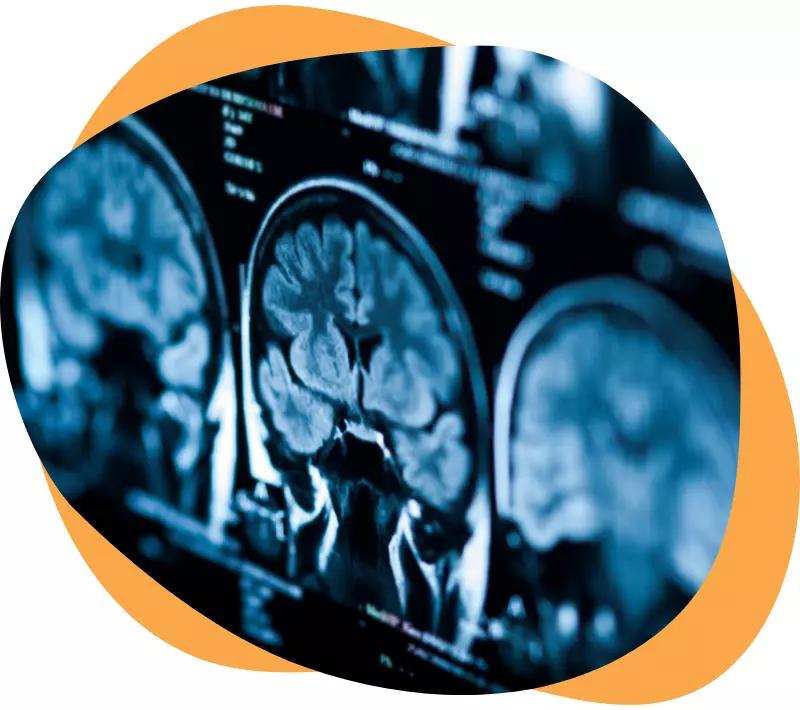
MRI plays a key role in diagnosing MS. MRI is a scan that shows detailed pictures of the brain and spinal cord. It can show lesions — scarred areas where myelin has been damaged.
For Parkinson’s disease, a standard MRI usually looks normal. Neurologists diagnose Parkinson’s by looking for bradykinesia (slowed movement) and at least one of the following symptoms:
A test called a DaTscan can help confirm the diagnosis in unclear cases. DaTscan shows how dopamine is working in the brain.
Overlapping symptoms like tremor and gait changes can make early diagnosis tricky for both conditions. Seeing a neurologist who specializes in MS or movement disorders makes a real difference.

The right diagnosis isn’t just a label — it determines the entire treatment plan.
MS now has nearly 25 U.S. Food and Drug Administration (FDA)-approved disease-modifying therapies. These medications slow the disease itself, reduce inflammation, and help prevent relapses.
Parkinson’s disease currently doesn’t have disease-modifying therapies. Every available Parkinson’s treatment option focuses on managing symptoms rather than slowing disease progression.
The goals of care differ, too. In MS, starting treatment early can protect the brain from future damage. In Parkinson’s disease, treatment focuses on staying active and maintaining quality of life for as long as possible.
Both conditions deserve early, accurate diagnosis from a knowledgeable care team. The right treatment for one will not work for the other. If something feels off, pushing for answers is always worth it.
On MyMSTeam, people share their experiences with multiple sclerosis, get advice, and find support from others who understand.
Have you ever had symptoms that could point to more than one condition? Let others know in the comments below.
Get updates directly to your inbox.




 Continue with Facebook
Continue with Email
Continue with Facebook
Continue with Email
Continue with Facebook
Continue with Email
Continue with Facebook
Continue with Email
Become a member to get even more





 Join
Join



 Your Privacy Choices

This is a member-feature!
Sign up for free to view article comments.
We'd love to hear from you! Please share your name and email to post and read comments.
You'll also get the latest articles directly to your inbox.