
Powered By



Meeting with your doctors over telehealth has been a game-changer for many people with multiple sclerosis (MS). This can lead some people to wonder whether they can use online vision screening tests to detect MS-related vision problems.
Eye symptoms and disorders, such as optic neuritis, double vision, and other non-MS-related problems, are common among people with MS.
In this article, we’ll cover whether online or mobile-based MS eye tests can be helpful in detecting these issues.
Sign up to view the results!
 Continue with Facebook
Continue with Email
Continue with Facebook
Continue with Email
Several online and at-home eye tests are available or in the process of being developed. These tools allow you to assess certain aspects of vision at home. The results can then be sent to your doctor for review and evaluation.
While some of these at-home tests may be useful for people with MS, others have limitations. Here are some details about which tests are available and what they can — and can’t — do.
Many MS experts recommend routine eye exams at least every other year for people with MS. These tests, which may be performed by optometrists or ophthalmologists, show:
During these tests, your doctor can track changes in your vision. If any are found, they can work with your neurologist to address them.
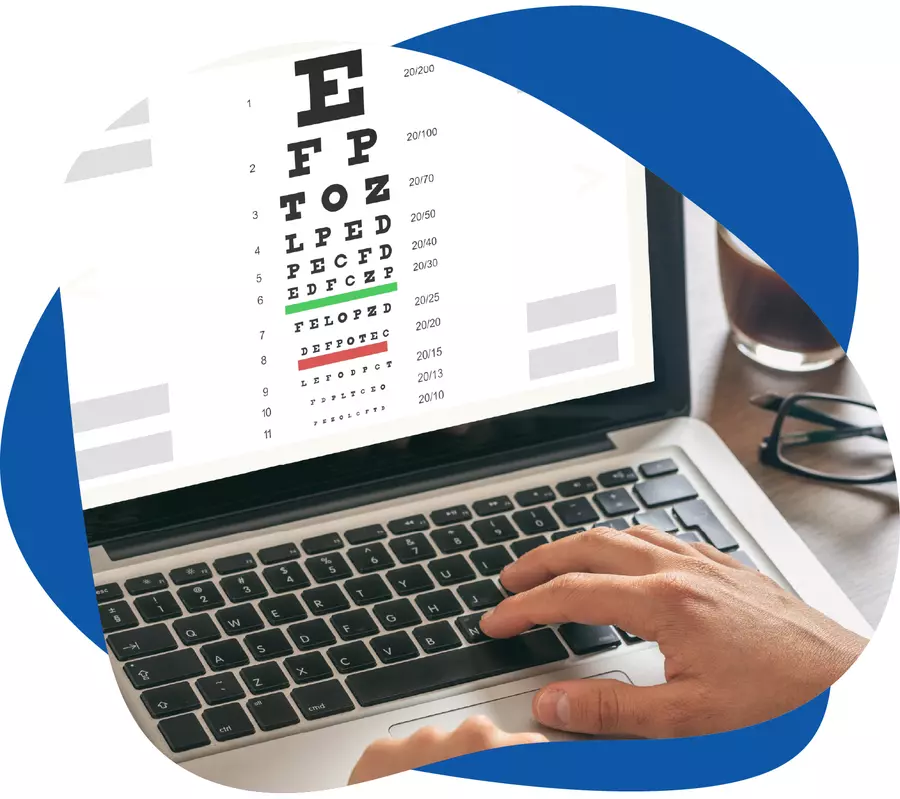
Some vision screening tests are offered online or via smartphone apps. During these tests, you’ll sit a specific distance away from an eye chart displayed on your computer or tablet screen. While covering one eye, you’ll then read each line on an eye chart to evaluate your vision.
At-home eye testing may help you detect some issues with your vision. But health experts say online eye exams aren’t as reliable as the comprehensive eye exams done in person by an eye doctor.
In-person vision screenings are more accurate than those done online. Plus, in-person tests make it easier for providers to detect other visual changes that could indicate the presence of other conditions that may or may not be related to MS.
Optical coherence tomography (OCT) tests measure retinal damage, as well as damage to the optic nerve fibers. These tests are important for monitoring MS eye damage and disease progression. They’re especially helpful in detecting previous or acute optic neuritis (inflammation of the optic nerve), which affects about half of all people with MS during the course of their disease.
Most OCT tests are performed in a doctor’s office. During this test, a machine scans your retina using infrared light to evaluate your eye health. But in recent years, at-home OCT tests have also become available.

These tests are performed remotely by the person with MS using a small device. The test results are then transmitted to the doctor for assessment.
Talk to your doctor about whether an at-home OCT test is right for you. One study of 3,539 participants found that image quality and results were similar for remote OCT tests and those performed in person. But the study was performed on people with a wide range of conditions, not just MS.
More studies are needed to determine whether remote OCT is useful for detecting eye issues in people with MS. Your doctor can explain whether they believe at-home OCT tests will be beneficial for your specific situation.
Some people with MS experience difficulties seeing colors. This is particularly true for people with a history of optic neuritis. Your doctor may want to perform color testing to see how well you can identify different hues.
One test to detect color vision changes is the Waggoner Computerized Color Vision Test (WCCVT). This digital exam tests your ability to see certain colors. One study found that the WCCVT was effective in detecting color vision issues in people with MS.
Digital color tests may not work the same way for everyone. This is due to a few reasons.
First, lighting might be different in one home versus another. This can affect your ability to distinguish colors.
In addition, screen calibration may vary from one device to another.
Your doctor can explain whether these at-home tools are right for you.
Some people with MS may develop an eye condition called nystagmus. It causes involuntary eye movements that you can’t control.
Your doctor can use tests to check for nystagmus, which may be present even if you haven’t noticed it. At-home eye movement tests can allow you to test remotely, often using a smartphone or tablet. The results are then sent to your doctor for review.
Digital eye movement trackers are still being perfected. While many show promise, your doctor may not find them accurate enough. Ask your care team about whether these may be helpful for you.
Many people living with MS should have an eye specialist such as an ophthalmologist or neuro-ophthalmologist on their care team. Their expertise is important in ensuring your eyes stay as healthy as possible and your vision remains clear and accurate.
 Researchers and scientists are continuing to make advances in mobile eye testing technology. While many of these tools are currently available, they may not measure up to in-person eye exams just yet.
Talk with your neurology and ophthalmology doctors to find out if they recommend any of these options for you.
Online and digital testing may be helpful in some cases. But you should get an in-person consultation if you have any vision changes, eye pain, or new or changing eye symptoms.
Your providers can help you get an accurate diagnosis and proper treatment to maintain your eye health.
On MyMSTeam, people share their experiences with multiple sclerosis, get advice, and find support from others who understand.
Have you tried online eye tests for symptoms such as blurry vision, vision loss, or other issues? Let others know in the comments below.
Get updates directly to your inbox.




 Continue with Facebook
Continue with Email
Continue with Facebook
Continue with Email
Continue with Facebook
Continue with Email
Continue with Facebook
Continue with Email
Become a member to get even more





 Join
Join



 Your Privacy Choices

This is a member-feature!
Sign up for free to view article comments.
We'd love to hear from you! Please share your name and email to post and read comments.
You'll also get the latest articles directly to your inbox.